The Constellation · 27 September 2026
We are alreadycyborgs
Where does the human end and the tool begin?
I
Already?
A phone rests on a desk. You reach for a memory that is not in the room.
A street you have never walked. A voice in another city. A thing you do by touching glass.
What disappeared: the tool, or a capability you had come to depend on?
In June 2016, on a stage at the Code Conference, Elon Musk answered a question about a closer link between people and machines by saying the link had already begun.
Image created by Grok.
On with Kara Swisher · We are already cyborgs
The passage Recode published from the full Code Conference interview, 1 June 2016.
“We’re already a cyborg.”
He meant the digital partial self: email, social media, the record of what you do. He meant the phone and the computer as powers a president did not have twenty years earlier. He also meant a limit. Getting an intention out through thumbs, he said, is ridiculously slow.
Sources for this chapter
- Musk, Elon. Interview by Kara Swisher and Walt Mossberg. Code Conference, Rancho Palos Verdes, 1 June 2016. Excerpt published as “We are already cyborgs,” On with Kara Swisher. Full interview, YouTube.
- Statt, Nick. “Elon Musk: We’re already cyborgs.” The Verge, 2 June 2016. The Verge.
II
The Word
Before the phone, the word had a narrower job.
An older word was already in the room. In 1948 Norbert Wiener published Cybernetics: Or Control and Communication in the Animal and the Machine. He was naming a study of control: an animal or a machine that keeps its course by answering its own signals. Cybernetics is a field. It is not a kind of person.
In September 1960, Manfred Clynes and Nathan Kline published “Cyborgs and Space” in Astronautics. They were asking how a human body might keep its own balance in a place it did not evolve for. Their answer was not a gadget in a pocket. It was an organism joined to devices that would regulate it without constant attention. The word takes its first half from cybernetics and its second from organism.
“For the exogenously extended organizational complex functioning as an integrated homeostatic system unconsciously, we propose the term ‘Cyborg.’”
If a person in space must keep checking the machines just to stay alive, they wrote, that person becomes a slave to the machine. The purpose of the cyborg was the opposite: let the added parts handle the robot-work, so the person can explore, create, think, and feel.
A pacemaker sits closer to that sentence than a phone does. It regulates without your looking. A phone waits for your hands. When Musk later says we are already cyborgs, he is using the word more widely than they did in 1960.
Sources for this chapter
- Wiener, Norbert. Cybernetics: Or Control and Communication in the Animal and the Machine. 1948. The MIT Press edition of that book: MIT Press.
- Clynes, Manfred E., and Nathan S. Kline. “Cyborgs and Space.” Astronautics, September 1960. Cyborgs and Space. A reprint is also held by The New York Times.
III
Outside the Skull
In January 1998 Andy Clark and David Chalmers asked where the mind stops and the world begins.
Inga wants the museum. She remembers it is on 53rd Street. Otto has Alzheimer’s. He writes the address in a notebook he always carries, and he consults it as readily as Inga consults memory. The philosophers argue that, in the respects that matter, the notebook plays the role a belief plays.
Ask a plainer question. What do the tools actually extend?
- Memory
- The note you did not trust to the afternoon.
- Knowledge
- A question answered by a library you do not carry.
- Navigation
- A city that answers before you are lost.
- Communication
- A voice that is not in the room.
- Action
- A payment, a light, a door, done at a distance.
- Identity
- The record other people meet, which is not the same as the person.
At the World Government Summit on 13 February 2017, Musk called this remainder a digital tertiary layer, and said that if you die, the digital ghost is still around. Emails and posts can outlast a body. They are traces. They are not someone still thinking.
Five ideas travel together in this conversation. A cyborg, an extended mind, a digital identity, a brain-computer interface, and a collective intelligence name different things. The “limbic system, cortex, digital layer” picture is his explanatory analogy, not an anatomy.
Sources for this chapter
- Clark, Andy, and David J. Chalmers. “The Extended Mind.” Analysis 58, no. 1 (January 1998): 7-19. The Extended Mind.
- Musk, Elon. Remarks at the World Government Summit, Dubai, 13 February 2017. Reported the same week by news.com.au. Catalogued at the Elon Musk archive.
IV
The Bottleneck
He kept returning to a difference you can feel in your own hands.
Input, by eye, is already a wide road into the brain. Output, by thumb or voice, is a narrow one. In the 2016 passage he called the gap many orders of magnitude. He did not publish a measured bit rate.
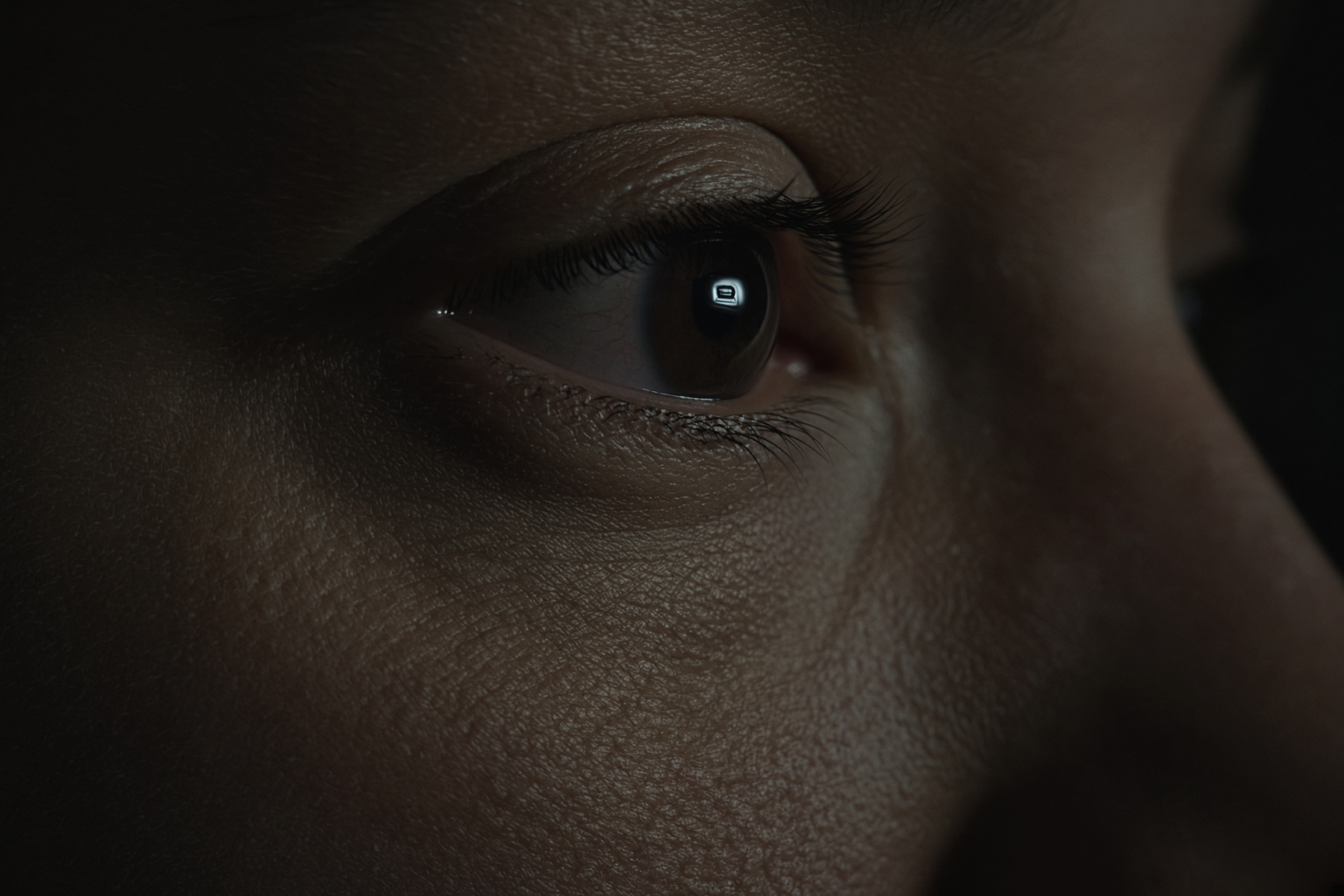
Input
Image created by Grok.

Output
Image created by Grok.
At SXSW on 11 March 2018 he returned to the same claim: the phone and the computer as extensions, and the limit as bandwidth, especially on the way out. Rough captions of that hour are easy to mishear. The sitting is the record.
A direct neural interface would not open someone’s whole mind to a machine. It would try to change the carrier between a specific intention and a device. That is a smaller sentence than the one science fiction prefers. It is the one the engineering can actually mean.
Image created by Grok.
SXSW · Elon Musk answers your questions, 2018
11 March 2018. Catalogued at the Elon Musk archive as the SXSW sitting.
Sources for this chapter
- Musk, Elon. SXSW, Austin, 11 March 2018. Elon Musk archive. Video door used here: Elon Musk Answers Your Questions.
V
The Interface
The analogy points at a machine. The machine has a slower biography than the sentence.
A brain-computer interface measures neural activity, decodes some of it, and uses the result as a command. A command is not a transcript of a thought.
2017
The tertiary layer, said aloud
In Dubai he separated the animal brain, the cortex, and a digital self. People already live with implanted devices that restore or regulate: pacemakers, cochlear implants. A pacemaker is not the link he is describing.
16 July 2019
A design, a robot, a hope
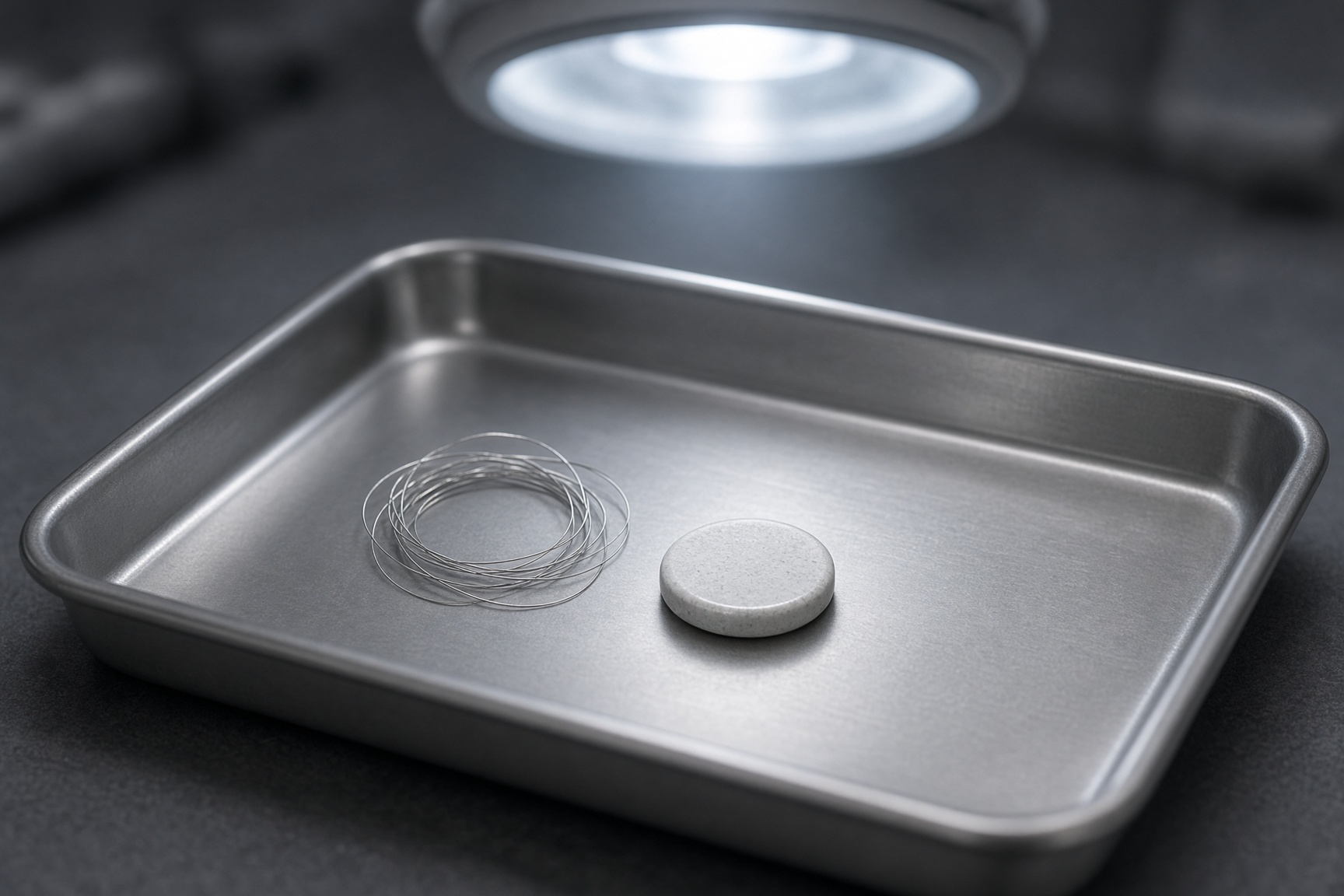
Neuralink’s launch event described thin threads, a robot to insert them, and a wish to reach a first human patient by the end of the following year. The Verge, reporting the company’s white paper that week, described arrays of as many as 3,072 electrodes across 96 threads. Musk also said a monkey had controlled a computer with its brain.
MIT Technology Review noted what the evening did not yet have: the public device behind the ear was a rendering of a future product, not the implant in use. The hope of a human patient in 2020 was not a 2019 fact. The first human implant came in January 2024.
Neuralink’s launch recording cannot be played on this page. The owner disabled it. The archive record catalogs the evening. It is not a second copy.
30 November 2022
Show and tell
The company showed a surgical robot and footage it presented as a monkey using an implant to move a cursor. Musk said the evening was, in large part, a recruitment. Demonstrations are not a finished medicine.
Reporting at the time also noted that the company had acknowledged a monkey’s death in testing. Animal demonstration, human therapy, and a promised future are three different rooms.
Image created by Grok.
Sources for this chapter
- Musk, Elon. World Government Summit, Dubai, 13 February 2017. Catalog: Elon Musk archive. Official one-minute highlight, not the full passage: World Governments Summit.
- Neuralink. “Launch Event.” 16 July 2019. The owner disabled playback on other sites, so this page does not embed it. It still opens on YouTube. Catalog: Elon Musk archive.
- Lopatto, Elizabeth. “Elon Musk unveils Neuralink’s plans for brain-reading ‘threads.’” The Verge, 16 July 2019. The Verge.
- Regalado, Antonio. “What’s new and what isn’t about Elon Musk’s brain-computer interface.” MIT Technology Review, 18 July 2019. MIT Technology Review.
- Neuralink. “Show and Tell, Fall 2022.” 30 November 2022. Neuralink on YouTube.
- O’Sullivan, Donie. “Elon Musk’s Neuralink shows brain implant prototype and robotic surgeon.” CNN Business, 30 November 2022. CNN.
VI
A Human at the Cursor
In January 2024 Noland Arbaugh, a man with quadriplegia after a spinal cord injury, became the first participant in Neuralink’s PRIME study. The study is investigational. It is not an approved consumer product.
On 20 March 2024 the company showed him moving a cursor and playing online chess. What was demonstrated is intended-movement decoding: signals associated with attempted movement, turned into control of a computer. A cursor is not a mind being read.
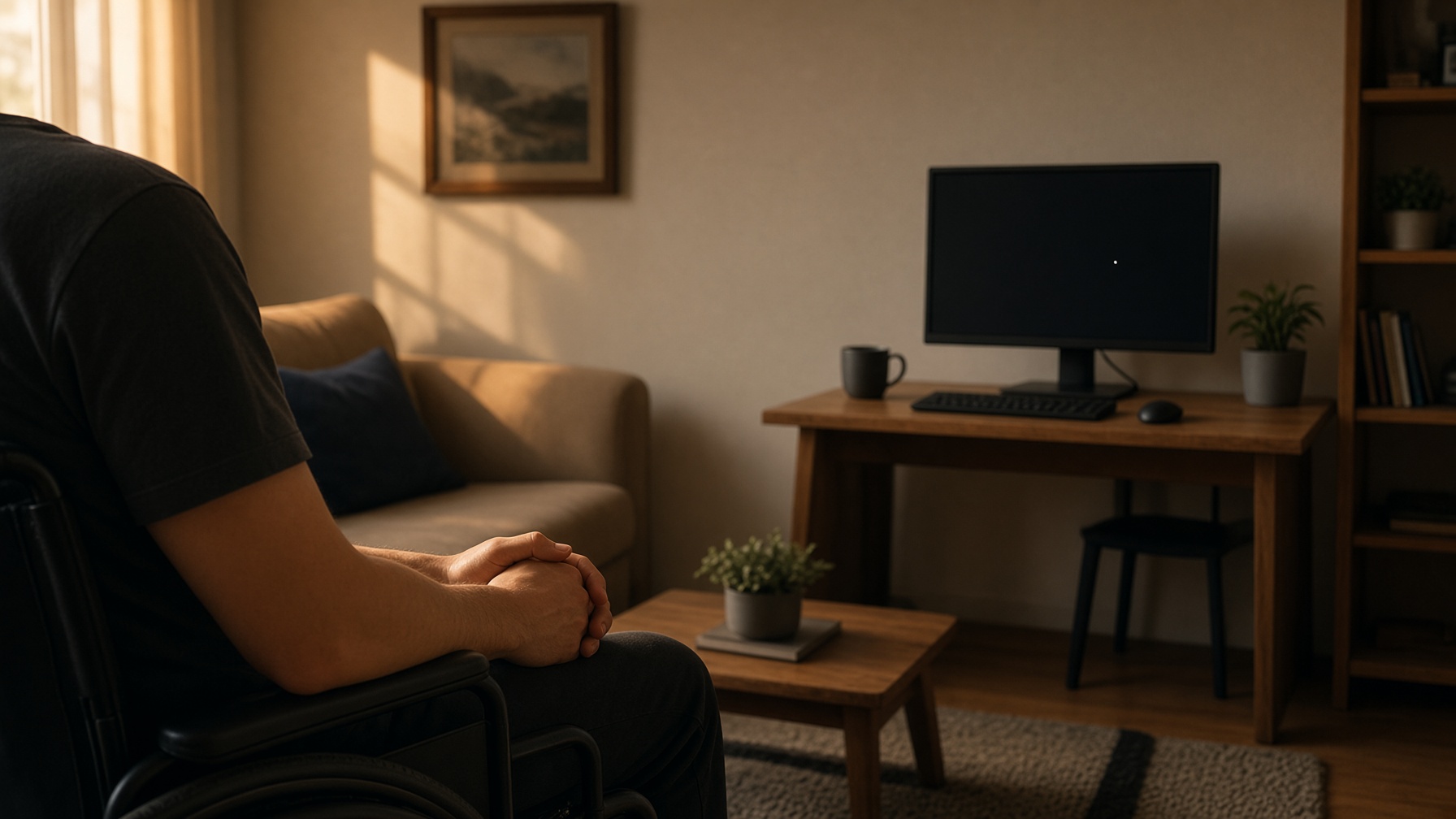
The picture is not him, and it is not the study.
The company’s own May 2024 update is the right place for the limits. Some threads retracted from the brain. The number of effective electrodes fell. Performance dropped. Software changes, not a second surgery, brought it back. On their grid task, Arbaugh’s first session was reported at 4.6 bits per second, and a later peak at 8.0. Neuralink said its engineers, using a mouse, scored about 10. Those numbers are the company’s. They are not an independent audit.
He was the first Neuralink participant. He was not the first person to use an implanted brain-computer interface. In the BrainGate studies, people with longstanding paralysis had already moved cursors and robotic arms with a 96-channel array. A 2012 paper in Nature reported two such participants reaching and grasping with a robot they commanded from motor cortex.
By January 2026 Neuralink reported a larger trial, cursor rates that sometimes overlapped ordinary mouse rates, and typing speeds up to 40 words per minute in a finger-mapping task. A separate speech study was described as aiming at conversational speed. Aims are not results.
Read the medical purpose first: restoring a way to act for people who cannot use hands. The wish to enhance people who can is a different ethical object.
The questions that belong beside any of this are ordinary and serious. Consent. Privacy of neural data. Surgical risk. Reliability when the signal changes. Who can update the decoder. Who can refuse the device. The difference between giving a capability back and proposing a new one.
Neuralink’s first PRIME progress update and the study brochure are the primary doors.
Sources for this chapter
- Neuralink. “PRIME Study Progress Update.” 2024. PRIME Study Progress Update. Brochure: PRIME Study Brochure.
- Neuralink. “PRIME Study Progress Update, User Experience.” 8 May 2024. Bits-per-second figures and thread retraction. User Experience.
- Neuralink. “Two Years of Telepathy.” 27 January 2026. Company report of later participant numbers, mouse-range cursor rates, and a 40-word-per-minute typing claim. Two Years of Telepathy.
- Hochberg, Leigh R., et al. “Reach and Grasp by People with Tetraplegia Using a Neurally Controlled Robotic Arm.” Nature 485 (2012): 372-375. Nature via PubMed Central.
VII
Where Do We End?
The phone is on the desk again.
If you take it away, some of what you can know and do goes with it. That was already true of a notebook. It is more densely true of a phone. It would be differently true of a device under the skull, because you cannot set that one down and leave the room.
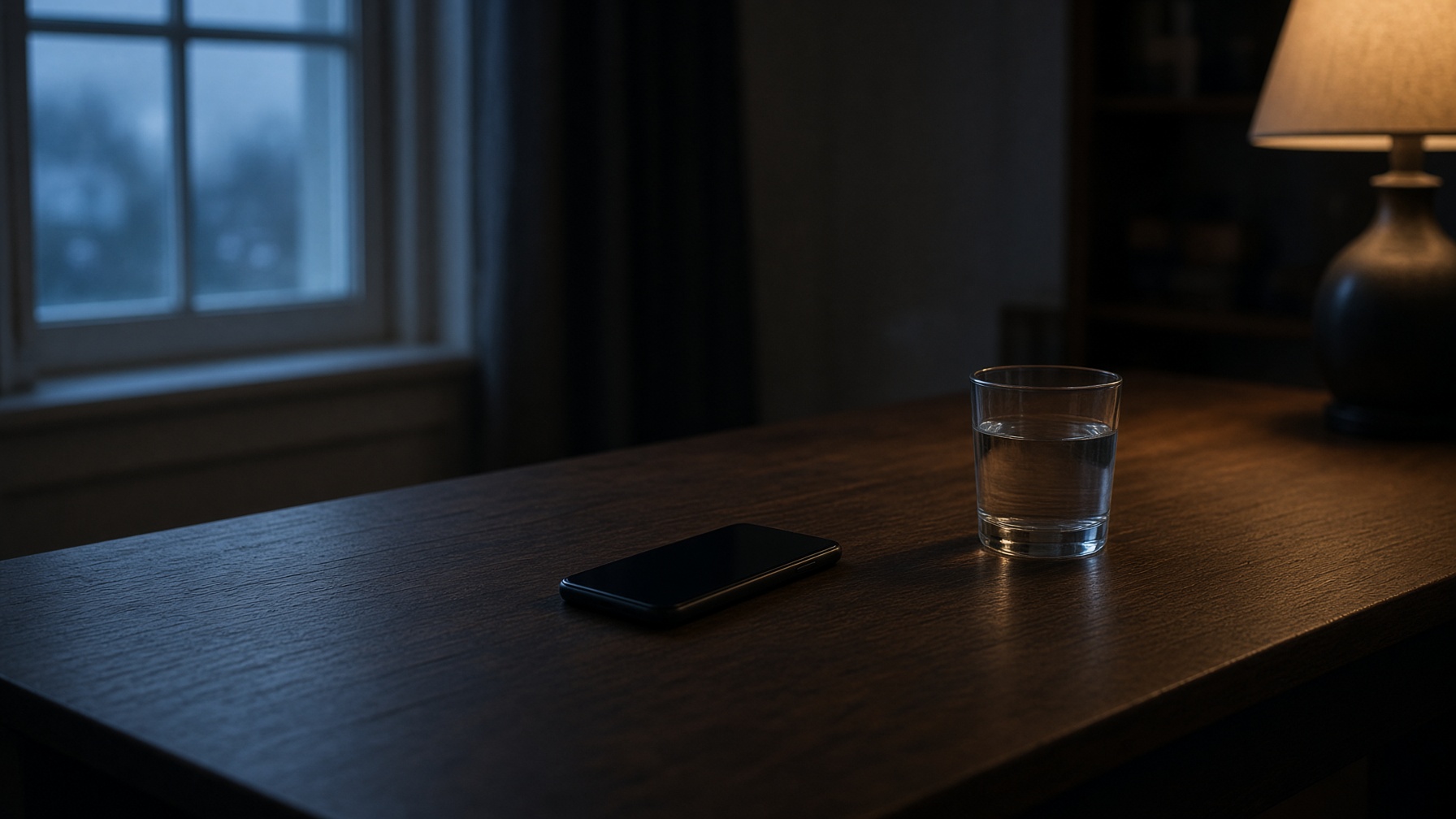
Inspect the two carriers. One leaves the body through a hand or a voice. The other tries to leave through a measurement.
Path one
Through the body
Path two
Through a decoder
Hand or voice
The body is the carrier. You can stop mid-gesture. You can put the tool down.
An explanatory instrument. It does not measure you.
An implant is one body and one device. People thinking with tools, together, are still people. That question is kept next door, in Collective Consciousness. A superorganism is another door: Superorganism. So is a Human-Machine Collective.
The same 2016 night also carried a simulation argument. It has its own door: Are We in a Simulation?
If our tools have already extended what we can know and do, what should guide the next extension?
Sources for this chapter
- Neighbor doors, linked because the distinction is earned here. Collective Consciousness. Superorganism. Human-Machine Collective. Are We in a Simulation?